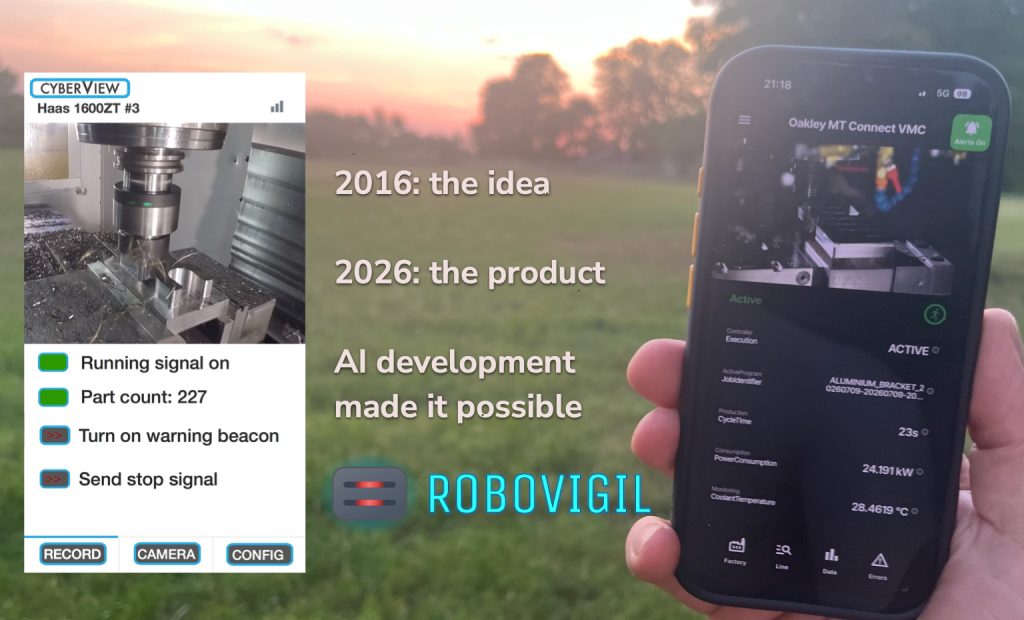

In 2016 I mocked up an app called CyberView. A camera pointed at a robot welding cell, a run signal, a part count, a button to send a stop signal to the cell. I knew from selling robots for a living that integrators and their customers wanted it. I also knew that building it properly, as a product rather than a one-off, was beyond what a small automation company could afford to have written.
Two years ago that changed. AI-assisted coding stopped being a novelty and became how software gets built. Every serious software team now uses it, and RoboVigil was built with it from the first line: ChatGPT, Cursor and Claude, used throughout for coding, investigation, documentation and problem solving. There is nothing unusual or risky about that in 2026. What matters is what you do with the leverage.
What got built
| Component | Scale |
|---|---|
| Cloud backend | 17 independent services, around 137,000 lines of code |
| Mobile and web app | 27 screens across iOS, Android, web and macOS, around 100,000 lines of code |
| Demo factory | 30 emulated machines and 23 virtual cameras on an isolated test network, around 55,000 lines of code |
| Machine types | ABB (IRC5 and OmniCore), FANUC, Universal Robots, MiR, OPC UA, MQTT and Sparkplug B |
| External integrations | 12 machine-side protocols and 8 third-party services, from robot controllers through to payments and push notifications |
| Development history | 14 months of code history, over 1,060 commits, 228 in the last 90 days |
Around 292,000 lines of code, live on the App Store and Google Play, in production use, and still under active development.
The tools are not the engineering process
AI writes the code quickly. It does not decide what to build, whether the result is right, or what happens when a customer’s robot faults at two in the morning. Architecture, requirements, testing, failure analysis and acceptance decisions are made by people. I lead the product, the architecture and the work on each machine type, and I do all the on-site verification against customer machines. Two experienced developers have supported the conceptual and structural design, the development approach and the app frontend.
The AI’s output is challenged rather than accepted. That judgement comes from 25 years of knowing what industrial robots do and what integrators need, and from the architecture discipline this project has demanded. Every functional change is verified end to end through the real app against the real backend before it is committed, so each commit is a complete, proven unit of work.
Why you can’t do it in a weekend
The same tools are available to anyone, and it is now easy to produce something that looks like RoboVigil in a weekend. A demo proves that something can work. A product has to deal with what happens when a robot disconnects, a camera dies, a service restarts, a network disappears, or two of those happen at once all while keeping everything secure. That is where most of the 292,000 lines have gone.
RoboVigil has been installed and tested against real ABB, FANUC, Universal Robots and MiR equipment at UK integrators, including machine faults, stops, reconnection and camera behaviour, across real mobile networks and real customer routers. The demo factory emulators reproduce the real controllers’ behaviour, several of them from traffic captured on the actual machines, so new work is tested against faithful targets before it goes near a customer. Every customer’s data is held separately, billing and user management are built in, and nothing has to be installed on the customer’s network: machines connect through the existing router over an encrypted tunnel.
Producing that took the strongest AI tools available, people who understand the machines and software security, a concept refined over ten years, and two years of verified engineering.
Where it is now
The first full-time demonstrator installation is being carried out for an integrator customer, and pricing has been agreed with a UK robot integrator for inclusion in their customer service-level agreements. The machine types are expanding to Yaskawa, KUKA, Modbus and MTConnect, and the platform is scaled to serve hundreds of machines per server. £150 per machine per month, all-in.