
If you’re evaluating cloud-based machine monitoring platforms, MachineCDN will come up. They’re an aggressive content marketer — their blog ranks for dozens of comparison keywords — and they position themselves as the fastest path from raw machine data to actionable intelligence. RoboVigil takes a fundamentally different approach to the same problem. This post lays out what each platform does, how they differ in architecture and philosophy, and which one makes more sense depending on your factory.
At a glance
| Aspect | RoboVigil | MachineCDN |
|---|---|---|
| Hardware required | None (optional Teltonika gateway for cellular) | Teltonika cellular gateway + LoRaWAN sensors (required) |
| Connectivity | Existing network + WireGuard VPN, or cellular via Teltonika RUT 276 | Cellular via bundled Teltonika gateway |
| Deployment | Remote software setup, same day | Sensor + gateway installation per asset |
| Protocols | OPC-UA, MQTT, UR RTDE, ABB RWS, FANUC robot Native, MiR | Vibration/temp sensors; also lists OPC-UA, MQTT, Modbus, EtherNet/IP, PROFINET, BACnet |
| Camera feeds | Yes — data snapshot + camera snapshot with every alert | No |
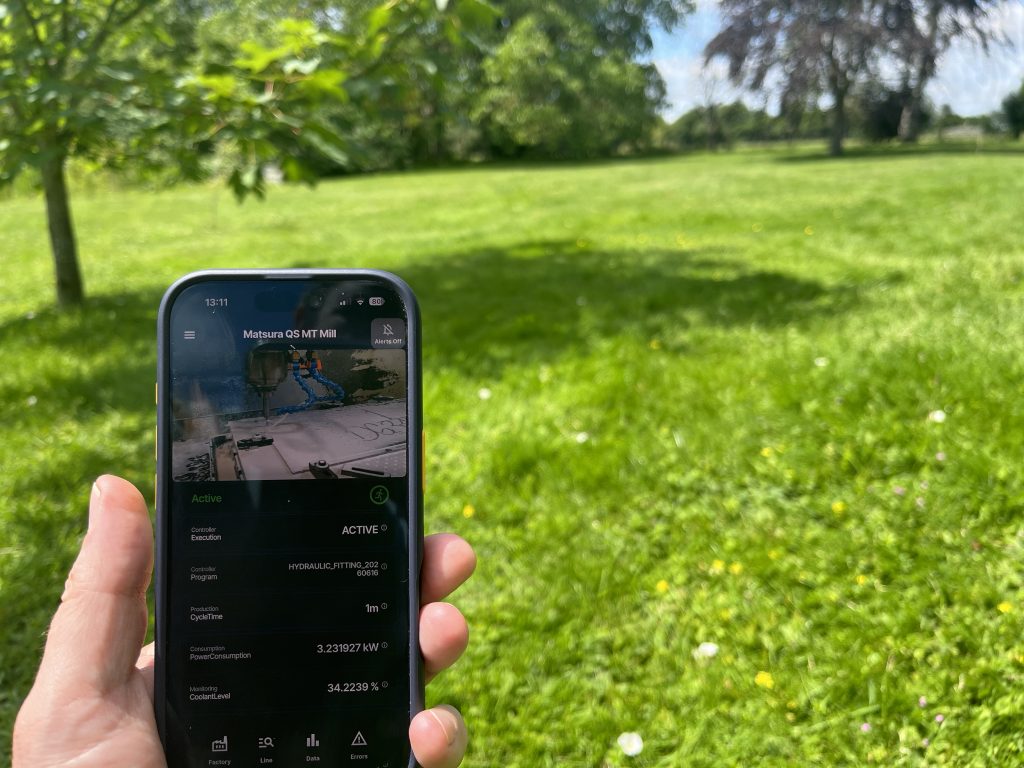
| Mobile-first | Yes — native iOS, Android, Amazon | Web dashboard |
| Pricing | £150/machine/month, all-in | $45/asset/month incl. sensor hardware |
| Best fit | Robots, CNC, mixed automation, remote oversight | Condition monitoring, HVAC, predictive maintenance |
What MachineCDN does
MachineCDN is an IIoT platform with offices in Plano, Texas and Skipton, England. They offer condition monitoring, predictive maintenance, OEE tracking, energy monitoring, downtime tracking, and alarm management. Their cloud runs on Microsoft Azure with OpenAI-powered analytics.
Their published pricing of $45 per asset per month bundles a bolt-on vibration and temperature sensor per asset, communicating wirelessly via LoRaWAN to a cellular gateway. The gateway itself is a Teltonika device — the same industrial hardware available from any distributor — bundled and branded as part of the MachineCDN package. The sensor data goes to their cloud over 4G/LTE, bypassing the factory network entirely. Their integrations page also lists OPC-UA, MQTT, Ethernet/IP, PROFINET, Modbus, and BACnet connectivity, though how these relate to the $45/asset sensor bundle isn’t clear from the website.
MachineCDN’s pitch is speed: they claim three minutes from plugging in the device to data flowing in the cloud. Because the gateway uses cellular rather than the factory network, there’s no IT involvement and no network configuration. The hardware is mandatory — there is no software-only option.
Their case studies include AT&T (IoT connectivity), KORE Wireless (global device management), Vertiv (commercial HVAC temperature monitoring), Emerson (retail equipment management), Grind2Energy (food waste recycling), and ACS Group (plastics processing equipment). The customer base leans towards HVAC, retail, telecoms, and sustainability rather than discrete manufacturing or robot cells. Their blog is extensive — they publish comparison posts against practically every platform in the space, from Azure IoT to MachineMetrics to Ignition.
What RoboVigil does
RoboVigil is a software-only monitoring platform built by Hagen Automation in Bedford, UK. There is no hardware at all — no edge devices, no sensors, no gateways, no cellular modems. It connects directly to machines over the factory’s existing network using the protocols they already speak: OPC-UA, MQTT, Universal Robots RTDE, ABB Robot Web Services. It also connects to existing IP cameras for live visual monitoring.
When a machine faults or enters an abnormal state, RoboVigil automatically captures two things: a data snapshot of the machine’s state at the exact moment of the event (fault codes, program state, cycle data, operating parameters — whatever the machine exposes via its protocol), and a camera snapshot from the linked IP camera. Both are delivered together as a push notification to your phone. A maintenance engineer sees what the machine reported, sees what the machine looked like, and decides whether to drive in — all from a single notification, without logging into anything.
For robots specifically, RoboVigil pulls detailed diagnostic data directly from the controller. On a Universal Robots cobot: safety status, program state, joint positions, protective stop reasons, and error codes via the native RTDE, Dashboard Server, and Primary Interface protocols. On an ABB IRC5: program state, motion data, and error logs via Robot Web Services. On a FANUC robot via OPC-UA: alarm history, cycle data, and program status.
Connectivity uses a WireGuard VPN tunnel on the factory’s existing router — outbound-only traffic, no inbound ports. For factories where the existing network isn’t an option or IT won’t cooperate, RoboVigil also works with off-the-shelf Teltonika RUT 276 industrial gateways with built-in cellular and WireGuard support — same VPN tunnel, same setup, no factory network involved. The difference from MachineCDN’s approach is that the gateway is optional, off-the-shelf, and not proprietary to the platform. RoboVigil is not an MES. It doesn’t do production scheduling, inventory management, or predictive maintenance modelling. It does monitoring and alerting: machine state, fault codes, cycle data, camera feeds, and push notifications to your phone. Native apps on iOS, Android, and Amazon Appstore. £150 per machine per month, every feature included.
Deployment: flexibility vs fixed architecture
MachineCDN ships hardware to your factory — a Teltonika cellular gateway and LoRaWAN vibration/temperature sensors. The sensors bolt onto each asset and communicate wirelessly to the gateway, which sends data to the cloud over 4G/LTE. The cellular connectivity means no IT network involvement, but you still have a physical installation project. Someone needs to mount each sensor, position the gateway for cellular and LoRaWAN coverage, and verify data flow. For a single machine, that’s straightforward. For 50 machines across three sites, it’s a logistics exercise. The hardware is mandatory — there is no software-only option.
The cellular approach introduces dependencies. Cellular coverage varies inside factories — thick concrete walls, metal structures, and basement locations can all affect signal. The gateway needs power and physical access for any maintenance.
RoboVigil gives you a choice. The default path is pure software: a WireGuard VPN on the factory’s existing router, connecting directly to machines over the network. No hardware shipped, no devices to mount, no SIM cards. If the factory has a working internet connection and machines with OPC-UA or MQTT, you can be monitoring the same day.
If the factory network isn’t available — IT won’t play ball, the network is locked down, or there simply isn’t one — RoboVigil works equally well with an off-the-shelf Teltonika RUT 276 industrial gateway. The Teltonika has built-in cellular and native WireGuard support, so the setup is identical: a VPN tunnel carrying machine data to the cloud, bypassing the factory network entirely. It’s the same Teltonika hardware that MachineCDN bundles into their package — but bought at market price from any distributor, and optional rather than mandatory.
Protocols and data depth
MachineCDN’s integrations page lists an impressive range: Modbus RTU/TCP, OPC-UA, MQTT, Ethernet/IP, PROFINET, and BACnet. On paper, that’s broad protocol coverage. In practice, their published $45/asset pricing bundles bolt-on vibration and temperature sensors communicating via LoRaWAN — the data you get at that price point is vibration (mm/s RMS), temperature, and derived condition metrics. Their API example on the integrations page shows exactly this: vibration, temperature, RPM, power draw, and a running/stopped status. That’s condition monitoring data, and it’s useful for predictive maintenance — detecting bearing wear, motor degradation, overheating.
What it isn’t is protocol-level machine data. A vibration sensor bolted to a robot cell doesn’t tell you which program was running when the fault occurred, what the protective stop reason was, what the joint positions were, or what fault code the controller logged. It tells you the motor was vibrating at 4.2 mm/s and the temperature was 72°C. Those are different types of information, useful for different purposes.
RoboVigil connects via OPC-UA, MQTT, and native robot protocols to read the data the machine’s own controller exposes. OPC-UA provides structured, semantically rich data with browse paths, node types, and companion specifications — named nodes like Machine/State/CurrentProgram with metadata about what they mean. MQTT supports structured JSON payloads from machines that publish their own data.
The native robot connectors go further still. Universal Robots RTDE provides real-time data at 500Hz including joint positions, safety status, and program state. ABB Robot Web Services is a REST API on the IRC5 controller that exposes program data, motion information, and error logs. These aren’t sensor readings bolted onto the outside of the machine — they’re the machine’s own data, from the controller, in real time.
The two approaches aren’t in competition so much as they serve different needs. MachineCDN’s sensor-based approach works on any machine with a motor, regardless of whether it has OPC-UA or any digital interface at all — bolt on a sensor and you’re monitoring. RoboVigil’s protocol-based approach requires a digital interface (OPC-UA, MQTT, or a supported native protocol) but delivers far richer data when one exists.
Alerts: data snapshot + camera snapshot
MachineCDN doesn’t offer camera integration. Their platform delivers sensor data — vibration, temperature, derived condition metrics — rendered as dashboards and analytics. When an alert fires, you get the sensor reading. You don’t see the machine.
RoboVigil combines both. When a fault or threshold breach triggers an alert, the system automatically captures a data snapshot (the machine’s full state at that moment — fault codes, program state, operating parameters, cycle data) and a camera snapshot from the linked IP camera. Both are delivered together in a single push notification to your phone.
This means an engineer receiving an alert at 2am doesn’t just see “Protective Stop — Axis 3” as a data point. They see the fault code, the program that was running, the joint positions at the time of the stop — and a photograph of the robot cell showing what actually caused it. A box jammed in a conveyor, a guard panel open, a part ejected onto the floor. Data tells you what the machine reported. The camera shows you what happened. Together, they give you enough information to make a decision without driving to site.
Alert history, data snapshots, and camera snapshots are all stored and searchable — giving you a complete audit trail of every event. Alerts are shift-aware, so machines don’t alarm during planned downtime or maintenance windows.
For factories running unattended shifts, lights-out production, or overnight robot cells, this combination of data and visual context in every alert is the feature that changes behaviour.
Pricing
MachineCDN’s pricing is $45 per asset per month. That includes an IP67-rated vibration and temperature sensor, LoRaWAN wireless connectivity via a Teltonika gateway, and full platform access with AI-powered diagnostics. No setup fees, no per-user charges, month-to-month commitment. Volume discounts bring it down to $38 at 51–200 assets and $32 at 201–500. It’s straightforward, transparent pricing — credit to them for publishing it.
What the $45 buys at the data level: vibration (mm/s RMS), temperature, and derived condition metrics from a bolt-on sensor. That’s condition monitoring — detecting bearing wear, motor degradation, thermal anomalies. It’s not protocol-level access to the machine’s own controller data (fault codes, program state, cycle times, production counts). MachineCDN’s integrations page lists OPC-UA, MQTT, Modbus, and other protocols, but the published pricing clearly bundles the sensor-based approach.
RoboVigil is £150 per machine per month. No hardware costs on the default deployment path because there’s no hardware — it connects over your existing network. No setup fees, no tiered features, no per-user charges, no minimum contract beyond monthly. For 50 machines, that’s £7,500 per month or £90,000 per year, with zero capital expenditure. If a site needs cellular connectivity, a Teltonika RUT 276 is a one-off purchase from any distributor — not a recurring platform charge.
On a pure price-per-asset basis, MachineCDN is cheaper. The comparison is whether you need sensor-level condition monitoring or protocol-level machine intelligence. MachineCDN’s $45 tells you the bearing is getting warm. RoboVigil’s £150 tells you the robot has thrown a protective stop on axis 3, shows you the fault code, the program that was running, and sends you a photograph of the cell.
Scope: what each platform is trying to be
MachineCDN is building a comprehensive IIoT platform. Beyond monitoring, they offer predictive maintenance with AI-driven failure prediction, preventive maintenance scheduling with spare parts tracking, materials and inventory management, energy monitoring per machine, fleet management across multiple sites, and OEE analytics. It’s a broad feature set aimed at being the single platform for manufacturing intelligence.
RoboVigil is monitoring and alerting. Machine state, fault codes, cycle data, camera feeds, and push notifications that deliver both a data snapshot and a camera snapshot with every alert. It doesn’t predict failures, manage spare parts, or track raw materials. It tells you what your machines are doing right now, alerts you when something goes wrong, and gives you the data and visual context to respond quickly.
That’s a deliberate scope decision. Many factories — particularly those running robot cells, CNC machines, or mixed automation — don’t need predictive maintenance AI or inventory management from their monitoring platform. They need to know when a machine has stopped, why, and whether it needs immediate attention. They need that information on their phone, not on a dashboard in an empty control room. If you want to understand the cost of not having even basic monitoring in place, read RoboVigil vs Doing Nothing.
IT involvement
MachineCDN’s cellular approach bypasses factory IT entirely. The Teltonika gateway sends sensor data to the cloud over 4G/LTE. IT never needs to open a firewall port, configure a VLAN, or approve a network change.
RoboVigil offers the same IT bypass when deployed with a Teltonika RUT 276 or RUT200— the same family of hardware MachineCDN uses, creating a WireGuard tunnel to the cloud without touching the factory network. RoboVigil also works without any gateway at all, using the factory’s existing router and internet connection. That path requires someone to add a WireGuard VPN configuration — a single file, outbound-only traffic, no inbound ports. It’s a 30-minute job for anyone who can access the router admin panel.
MachineCDN always bypasses IT, always requires hardware. RoboVigil can bypass IT with the same off-the-shelf hardware, or use the existing network with no hardware at all.
Who should choose what
Choose MachineCDN if you need condition monitoring on assets that don’t have digital interfaces — motors, pumps, compressors, HVAC equipment — where bolt-on vibration and temperature sensors are the right approach. Their $45/asset price point is competitive for sensor-based monitoring with predictive maintenance AI, and the cellular bypass eliminates IT friction. Their case studies and feature set position them strongly in HVAC, process equipment, and general asset health monitoring.
Choose RoboVigil if you run robots — UR, ABB, FANUC — and want native protocol access to controller data, you want alerts that deliver both a data snapshot and a camera snapshot so you can assess faults without driving to site, you need mobile-first remote monitoring with push alerts as the primary use case, you want the flexibility to deploy with no hardware at all or with an off-the-shelf cellular gateway depending on the site, your machines already expose OPC-UA or MQTT and you want to be monitoring the same day, or you prefer a UK-based platform with transparent pricing at £150/machine/month.
For factories that already have SCADA or an MES and want to add lightweight cloud-based remote monitoring alongside it, RoboVigil slots in without conflicting. For factories that have nothing and want a single platform to handle monitoring, maintenance, and materials, MachineCDN is aiming to be that platform.
If you’re also evaluating UK-based alternatives, see RoboVigil vs FourJaw for a comparison of two different approaches to the same problem. For a comparison against the biggest name in the CNC monitoring space, see RoboVigil vs MachineMetrics.
Try it yourself
RoboVigil has a live demo factory you can explore right now — real software, simulated machines, working camera feeds. Download the app from the App Store, Google Play, or Amazon Appstore and log in to see what monitoring looks like before you commit a penny. Or sign up at robovigil.com and connect your first real machine in under an hour.